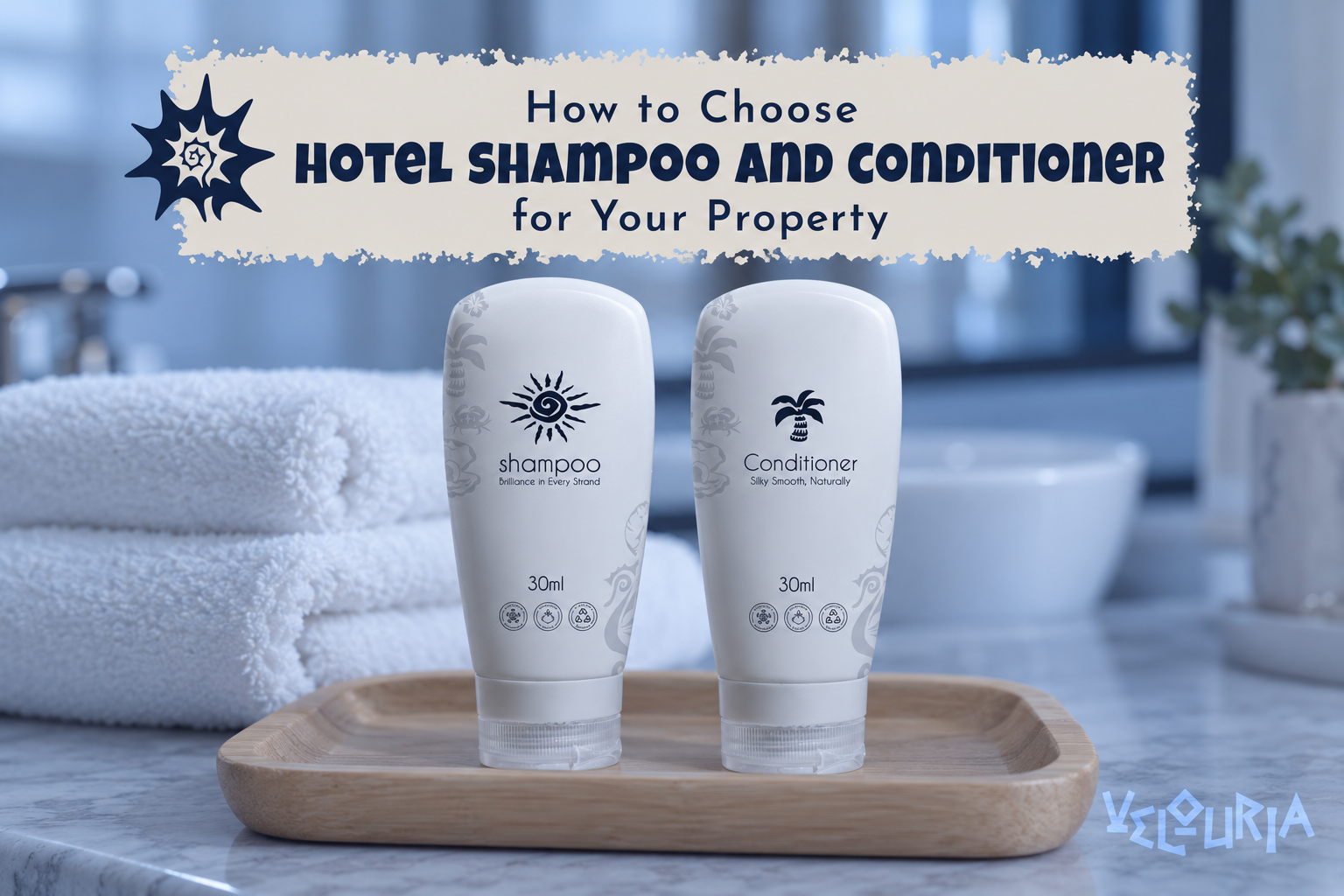
Learn how to choose hotel shampoo and conditioner that suit your guests, complement your brand and balance product quality, packaging, and reliable Gulf supply.
What Should You Look for in Hotel Shampoo and Conditioner?
Hotel haircare products should balance cleansing performance, comfort, presentation and operational practicality. An attractive bottle can strengthen the bathroom’s appearance, but the formulation inside must also provide a satisfying experience.
Start with a written specification covering product functions, preferred packaging, estimated consumption and budget. This makes comparisons more meaningful than choosing products from photographs or price lists alone.
How to Choose Hotel Shampoo and Conditioner for Different Guest Profiles?
- Hotels welcome guests with fine, thick, dry, oily, curly and colour-treated hair. A broadly suitable formulation is a practical starting point, although an “all hair types” label cannot guarantee identical results for everyone.
- Assess whether the shampoo cleanses effectively without leaving an excessively stripped feeling. Evaluate whether the conditioner spreads easily, supports detangling and rinses away without an unwanted heavy finish.
- Match the selection to your property’s positioning. A business hotel, extended-stay apartment and luxury resort may require different product formats and presentation standards.
Check Ingredients and Supporting Information:
- Request the complete ingredient list rather than relying only on highlighted botanical ingredients.
- Aloe vera, chamomile, rosemary, green tea, argan oil and almond oil may appear in haircare formulations. However, their presence alone does not establish the performance or suitability of the finished product.
- Sulphate-free and paraben-free options may suit your purchasing specification, but these descriptions are not automatic measures of safety or quality. Preservation, formulation balance and appropriate product testing remain important. Natural ingredients can also cause sensitivity in some users.
Should Hotels Provide Separate Shampoo and Conditioner?
- Separate products allow guests to cleanse and condition according to their hair’s needs. Shampoo removes accumulated oil and residue, while conditioner helps improve softness, manageability and detangling.
- For upscale properties, providing both products offers a more complete haircare experience. It also gives guests the choice to use conditioner where needed rather than receiving the same combined formulation every time.
- Two-in-one products can simplify purchasing and reduce the number of containers. Their suitability depends on the formulation, guest expectations and service model; they should not automatically be dismissed as harsh because they combine functions.
- Evaluate separate shampoo and conditioner together during sampling. Consider the finished feel after drying, particularly where guests may also experience frequent swimming, air-conditioned environments or different water conditions.
- Water hardness can affect the washing experience, so testing products using the property’s actual water supply is more useful than assuming performance will be identical everywhere.
How to Choose the Right Fragrance for Hotel Toiletries?
Fragrance contributes to the bathroom experience, but it should complement the stay without overwhelming the guest.
Choose a Balanced Scent:
Look for a pleasant fragrance with controlled intensity. Consider how the shampoo and conditioner interact with shower gel, body lotion and any existing room fragrance.
A coordinated scent can create consistency across the collection. However, the strongest or longest-lasting option is not necessarily the most suitable, particularly for guests who prefer subtle products.
Test Fragrance During and After Use:
Evaluate fragrance from the bottle, during washing and after rinsing. These impressions can differ.
Ask evaluators to record whether the scent feels balanced and whether it remains noticeable after drying. Avoid choosing the entire collection from a quick assessment of an unopened sample.
Where relevant, ask about fragrance-free alternatives and ingredient information. Do not assume that an unscented description confirms the absence of all fragrance-related ingredients.
Choose Suitable Bottle Sizes and Packaging Formats:
Packaging affects guest convenience, housekeeping workload, product waste and storage requirements. When deciding how to choose hotel shampoo and conditioner, assess the container and formula as one system.
Individual Bottles and Tubes:
- Miniature bottles and tubes provide individual presentation and can suit properties where portable amenities form part of the guest experience.
- Sizes such as 20 ml, 30 ml or 50 ml should be evaluated against expected use, occupancy and length of stay. These are comparison examples, not a statement of Velouria’s available sizes.
- Check whether guests can open the closure easily, distinguish shampoo from conditioner and dispense the product without excessive effort. Attractive packaging loses value when thick conditioner remains trapped inside.
Dispensers and Bulk Formats:
- Wall-mounted dispensers or sealed cartridge systems may reduce the number of miniature containers used. Their operating costs depend on consumption, installation, maintenance, labour and replacement requirements.
- Prefer designs that restrict unauthorised access, and verify that the product’s viscosity works with the pump.
- Housekeeping teams need clear instructions for inspection, cleaning and replenishment. Avoid casually topping up partly used containers; follow the system’s documented hygiene procedure.
Assess Environmental Claims Carefully:
- Review the complete packaging specification before accepting descriptions such as recyclable, biodegradable or plastic-free.
- Wheat-straw composites, for example, may contain conventional polymers. Their plant-based component does not automatically make the finished container biodegradable or suitable for local recycling.
- Request evidence about materials and disposal conditions. Product selection can support sustainability goals, but it does not independently establish a hotel’s overall ESG compliance.
How to Test Hotel Shampoo and Conditioner Samples?
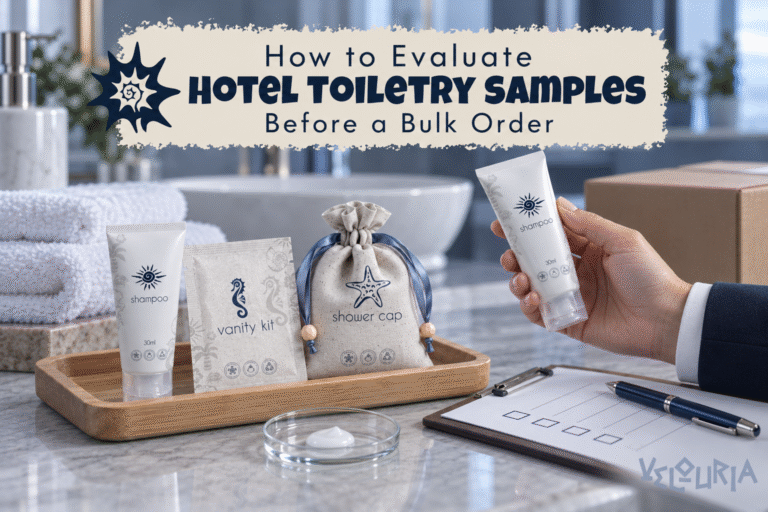
Samples help purchasing teams compare the actual experience with the written specification. Use the same evaluation method for every shortlisted option.
Test the Products as a Pair:
- Assess shampoo and conditioner together under normal use conditions. Include a small group of willing adult evaluators with different hair characteristics, without treating an informal trial as a clinical safety assessment.
- Record observations on cleansing, rinsing, detangling, fragrance and the finished feel after drying. Stop use if irritation occurs and follow the appropriate reporting procedure.
How to Choose Hotel Shampoo and Conditioner: Sample Approval Checks?
Before approving production, confirm:
- The sample and formula references.
- Bottle size, closure and label readability.
- Dispensing performance and packaging integrity.
- Fragrance and texture consistency.
- Approved artwork and product identification.
Include procurement and housekeeping in the review. Procurement can assess specifications and commercial terms, while housekeeping evaluates storage, handling and room preparation.
Retain an approved reference sample where practical. Record acceptance criteria so later deliveries can be checked against an agreed specification.
What to Confirm with a Hotel Toiletries Supplier Before Ordering?
A suitable product must be supported by clear purchasing terms and dependable communication. Compare suppliers using consistent requirements.
Minimum Quantities and Production Times:
Ask whether minimum order quantities differ between standard products and customised packaging.
Separate the time required for samples, artwork approval, production and transport. Confirm when the lead-time calculation begins and whether repeat orders follow the same schedule.
For properties approaching an opening date or busy season, agree delivery requirements before finalising the order.
Documentation and Quality Control:
Request relevant ingredient information, product identification, batch traceability and storage instructions. Confirm the documentation required for the destination market and the party responsible for providing it.
Ask how formula changes, packaging substitutions and quality complaints are communicated. Establish a written process for reporting damaged, leaking or incorrect products.
Total Cost and Delivery Terms:
Compare equivalent quantities and volumes. A lower bottle price may reflect a smaller fill size or exclude additional services.
Include:
- Product and packaging costs.
- Artwork or printing charges.
- Freight and applicable taxes.
- Dispenser equipment, where relevant.
- Expected wastage and replacement costs.
Velouria offers its products to all Gulf countries: the United Arab Emirates, Saudi Arabia, Kuwait, Qatar, Bahrain and Oman. Share your delivery destination when requesting a quotation so quantities, documentation and shipping arrangements can be discussed for the intended market.
Create a Better Guest Experience with Velouria:
Choosing haircare amenities is an opportunity to make everyday guest routines feel considered and consistent. Focus on formulations that perform well, packaging that works in practice and purchasing terms your team can manage confidently.
Velouria brings an eco-luxury approach to guest amenities for hotels and resorts across all Gulf countries, combining an elegant collection with a focus on quality and environmental responsibility.
Explore Velouria’s shampoo and conditioner collection and discuss your property’s requirements with the team. Provide your estimated quantities, preferred presentation and delivery location to request a tailored quotation.
Contact Velouria today and take the next step towards a coordinated guest amenity experience.
FAQs About How to Choose Hotel Shampoo and Conditioner:
What makes a good hotel shampoo and conditioner?
A suitable pair provides effective cleansing, manageable hair, balanced fragrance and practical dispensing. Evaluate the finished formulations, packaging and supporting product information together.
Should every hotel offer separate conditioner?
Separate conditioner gives guests more choice and is particularly relevant to a complete upscale haircare offering. The final decision should reflect guest needs, property standards and the operating model.
Are sulphate-free products always better?
No. Sulphate-free describes an ingredient choice rather than guaranteeing superior performance. Assess the complete formula, intended use and sample results against your purchasing requirements.
What bottle size should a hotel choose?
Use expected consumption, stay length and room occupancy to guide selection. Test the proposed size in practice and review leftover product before committing to a larger order.
Are dispensers cheaper than miniature bottles?
They can be, but savings are not automatic. Compare product consumption, equipment, servicing, housekeeping time and packaging waste to estimate the actual operating cost.
Can shampoo and conditioner packaging carry the hotel’s identity?
Ask Velouria which customisation options are available for the selected products. Confirm artwork requirements, minimum quantities, sample approval and production times before ordering.
Does Velouria supply hotel amenities across the Gulf?
Yes. Velouria offers its products to all Gulf countries. Contact the team with your destination, product requirements and quantities to discuss a suitable quotation.